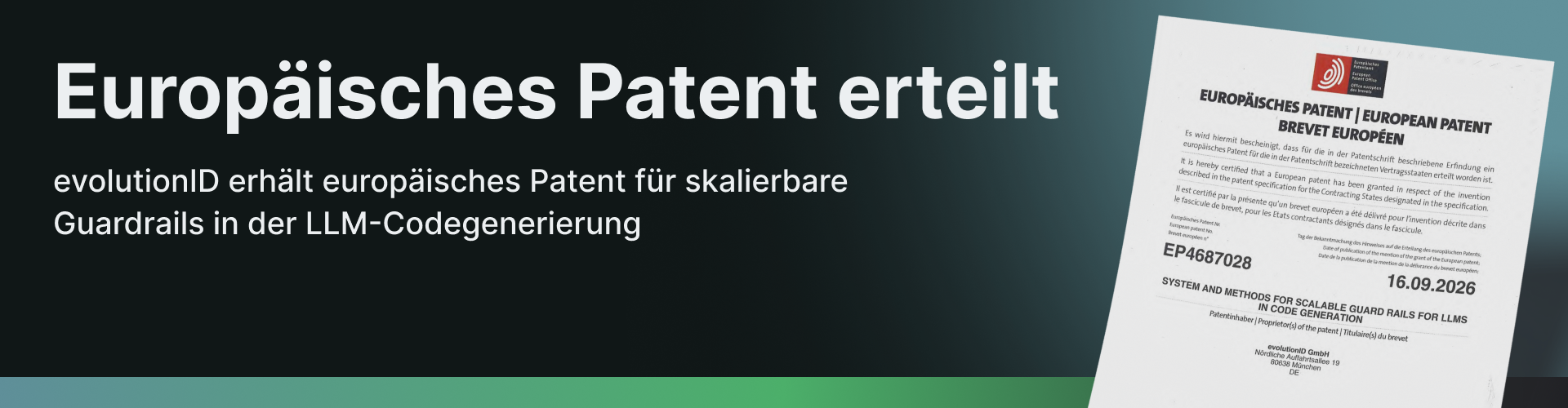
evolutionID Granted European Patent for Scalable Guard Rails in LLM Code Generation
evolutionID Granted European Patent for Scalable Guard Rails in LLM Code Generation
The patented GRID process applies access control principles to LLM generation, establishing a new foundation for controlled AI in PIAM and access control environments.
Posted by
Lizelle Maas
Posted date
October 8, 2026
The patent protects the technology behind GRID, which brings role-based access rules directly into the LLM generation process, with important implications for the use of AI in access control and PIAM.
Munich, October 2026 – evolutionID GmbH has been granted European Patent EP4687028 for “System and Methods for Scalable Guard Rails for LLMs in Code Generation.”
The patent covers technology developed as part of Gevaluated againstD, evolutionID’s research into controlling what large language models are able to generate when operating within defined permissions.
As AI becomes more deeply integrated into operational systems, including Physical Identity and Access Management (PIAM), the question is no longer only what an AI can do. It is also what it should be allowed to do on behalf of the person interacting with it. GRID addresses that problem at the generation level.
Bringing access rules into LLM generation
In a conventional setup, an LLM may generate a command first, with permissions or policy checks applied afterwards. GRID takes a different approach. Role-based access rules can be incorporated into the decoding process itself, constraining which outputs are available to the model as it generates them.
In practical terms, if a user has permission to read information but not modify or delete it, those restrictions can also constrain what commands the LLM is able to generate on that user’s behalf.
This has particular relevance for access control and PIAM as AI moves beyond answering questions and begins interacting with systems, workflows, and administrative functions. The principle is familiar from identity and access management: a user’s permissions determine what they are allowed to do. GRID extends that principle into the generation process of the AI acting on their behalf.
“The important part of GRID is not simply constrained decoding. The patented technology allows GRID to act as an access-control layer for code generation by LLMs, so the permissions of the user can determine what the model is able to generate. We have also shown that this can be done while remaining competitive in performance and accuracy with leading decoding technologies. For us, this is where AI and access control really come together.” — Mohsen Arjmandi, CTO, evolutionID GmbH
From patented design to published research
The work behind GRID has also been evaluated against established grammar-constrained decoding technologies.
Benchmarking presented in the GRID research compares its performance and accuracy with libraries including llguidance and XGrammar. The results show that role and policy constraints can be introduced while remaining competitive with current grammar-decoding approaches. The underlying research describes explicit guarantees around soundness, completeness, termination, and per-token computational cost.
GRID benchmark results compared with llguidance and XGrammar across performance and output validation metrics.
A foundation for controlled AI in access systems
For evolutionID, GRID builds on the longstanding focus on identity, permissions, and governed access.
As AI becomes capable of interacting directly with access-control environments, applying those principles to the AI itself becomes increasingly important. The goal is not simply to add AI functionality to existing systems but to make its permitted actions explicit and enforceable.
The European patent marks an important milestone in that work and protects the underlying approach developed by the evolutionID research team.
“This work sets an important benchmark for where we believe PIAM needs to go. Innovation in access management is not only about solving today’s requirements but also about anticipating how technologies such as AI will change the way access is managed in the future.” — Ali Gülüm, CEO, evolutionID GmbH
About GRID
GRID, or Grammar-Railed Decoding, is a grammar-constrained decoding technology developed by evolutionID. It is designed to apply structural and role-based constraints during LLM generation rather than relying solely on validation after an output has been produced.
More technical detail on GRID, including its architecture, guarantees, limitations, and benchmarking, is available inevolutionID’s Technical Insights and the published research paper.
About us
For more than two decades, evolutionID has helped organizations bring clarity and control to identity and access. We focus on what matters most: secure, reliable processes that are simple to operate and built to last.
We bring together Physical Identity & Access Management (PIAM), card and employee management, and RFID‑supported workflows into one coherent approach. Our modular building blocks allow identity and access systems to adapt over time—without disrupting what already works. The result is less complexity, more transparency, and greater confidence in everyday operations.
As a long‑term partner, we guide our customers step by step—from analysis and architecture to implementation, migration, and ongoing support. With teams in Munich, Bonn, and Frankfurt, we work closely with organizations across the DACH region to create access infrastructures that stay secure, stable, and ready for what comes next.
We take good care of you and your data. You can read more about how we use cookies, the third parties who set cookies and update your cookie settings here.
Thank you! Your submission has been received!
Oops! Something went wrong while submitting the form.
We use cookies and similar technologies to help personalise content, tailor and measure ads, and provide a better experience. By clicking OK or turning an option on in Cookie Preferences, you agree to this, as outlined in our Privacy Policy.